Water runoff can cause soil to erode and wash away. While erosion is a natural process, when it occurs on land that is occupied by humans it can become problematic. The urbanization of the landscape, particularly the soil compaction that occurs under buildings, sidewalks, parking lots, and the like may increase the threat of erosion. Of the different types of runoff-induced erosion, there are four that are considered the most prominent. What follows is a brief explanation of each type of erosive process.
Sheet
This is one of the most common forms of erosion with sheets of water moving across the surface. This can result in the transportation of the soil by raindrops. The sheet effect may also cause the soil particles to become loose due to the movement of other soil particles because of the rain intensity.
Sheet erosion occurs on soil that is generally flat or has no compromises in the surface. Continued sheet erosion may cause rills to form.
Rill
This is one of the most common forms of erosion with sheets of water moving across the surface. This can result in the transportation of the soil by raindrops. The sheet effect may also cause the soil particles to become loose due to the movement of other soil particles because of the rain intensity.
Sheet erosion occurs on soil that is generally flat or has no compromises in the surface. Continued sheet erosion may cause rills to form.
Gully
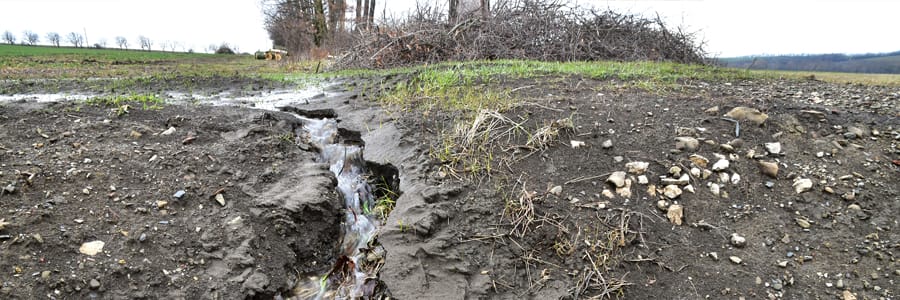
Gullies form as a result of rills that get deeper than 75mm. When the water flows into a gully, it can start to remove the sediment at a faster rate. This is especially true if the gullies are located on a slope. The water flows through a gully at a faster rate compared to flowing over the soil. The result is a dramatic increase in the erosion rate of the soil.
While rills can be addressed relatively easily, gullies are much more difficult due to their depth. This means that it is more time-consuming and costly to repair a gully.
Channel
This is erosion that occurs along the banks and beds of stream channels. When the water flow increases, erosion may occur at a greater rate. Such increases in water flow in channels may happen because of soil compaction due to the presence of sidewalks, parking lots, and other hard surfaces that only accelerate the water into streams.
The result is that sediment flows at a faster rate before becoming deposited. Such deposits occur in areas where the water flow is not sufficient to maintain the movement of the sediment.
The erosion process from sheet to rill, gully, and finally channel is not an inevitable one. It depends on several different factors. But what is true is that rills when left untreated may form into gullies over time. Channels tend to form under a constant flow of water such along a stream.
Tag: soil, Sediment, potential, Erosion, Calgary, assessing, annual