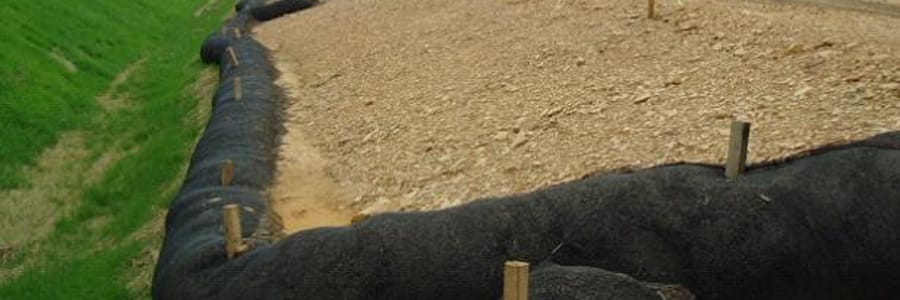
You must allow for sufficient space for the water to pond behind the berm or sock which traps it in place, so that it limits the amount of erosion that may occur. This means that a berm or sock must be created on a contour with the run end or ejection point facing upstream. The result will be a limitation on the amount of run-off that is created.
Construction Materials
To create a proper berm or sock that meets city standards, you must use a well-graded mix of particles that range from coarse to fine. The combination of such particles adds strength and durability to the berm or sock that has been created.
When constructing a berm or sock, be sure to leave some space between the toe or end of the slope and the device itself. This will help the berm or sock maintain proper capacity when in use.
Inspection
You will need to inspect all berms or socks that are constructed on a contour. Sediments can build up inside such devices quickly, especially after a rain or other precipitation. Plus, regular inspections will catch a more gradual buildup of sediment inside the sock or berm.
And even berms or socks that are properly constructed wit the right materials can fracture, crack, or start to erode on their own. Regular inspections can catch issues before they become major problems. Such issues need to be corrected quickly to maintain the integrity of the berm or sock.
Removal
Once the sediment reaches at least one-third the height of the device, it should be removed and disposed of in a place that is safe from run-off. You can always remove the sediment before it reaches that height, but it must be removed once it is one-third the way up the berm or sock.
Inspection
Once such traps and basins are completed, they will need to be frequently inspected and any accumulated sediment must be removed. By maintaining a regular schedule that include hourly, daily, or weekly inspections combined with inspections that occur after a precipitation event, you can adequately monitor the buildup of sediment in traps and basins.
Once one-third of the settling volume has been reached, the sediment must be removed from the basin or trap. The sediment must be disposed of in an area that is not subject to heavy water run-off.
Skimmer
You may want to install a skimmer device that controls the dewatering of the basin or trap. Such devices can be quite helpful when it comes to removing sediments while maintaining standards as set by the city.
Tag: construction, erosion control, Sediment Control, ESC, water, berm, compost, socks