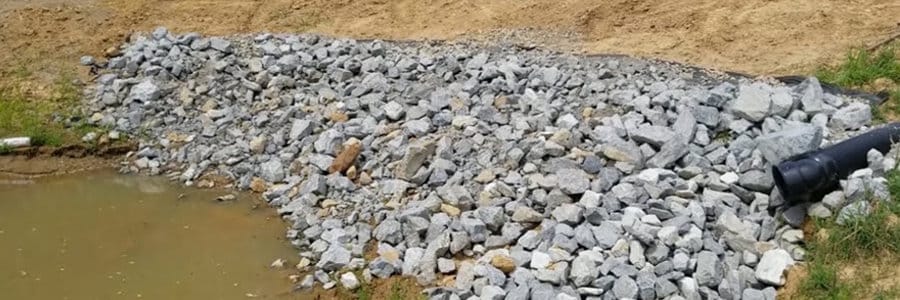
Consisting of loosely placed cobbles or boulders, riprap is an excellent, versatile material that is resistant to erosion. The purpose of riprap is to protect the surface of the soil from the erosive elements of sun, wind, and precipitation. It consists of a layer of suitable rock that provides better stability on slopes of soil that are subject to seepage or are poorly structured. Riprap may be a temporary or permanent measure depending on the need. And their placement on steep slopes helps to channel away the water runoff to help protect the surface.
Implementation
Riprap is best used after grading and before a significant precipitation event can occur. It is best to schedule the placement of riprap immediately after the soil has been graded if possible.
– There is uniform and graded riprap. Graded includes different sizes of stone while uniform uses roughly the same sizes of stone.
– Graded riprap is less expensive, easier to install, and can form a thick layer of protection that still provides some flexibility
– The stone used should be resistant to erosion. But avoid sedimentary rock
– Such stones should be angular and hold up against weathering and water
– Specific gravity should be no less than 2.5
Filler Blankets
This is a layer of material that is positioned between the underlying soil and the riprap. It prevents the movement of the soil into or through the riprap. The blankets may consist of a gravel-sand layer, well-graded gravel, or a non-woven geotextile filter fabric that is suitable to the job it must perform. The filler blankets use gravel that is based on the ratio of particle size found in the overlying filter material compared to the base material.
Subgrade Preparation
– The subgrade for the riprap and filter material should be prepared based on the required elevations and grades that are needed
– Compact all filler materials in the subgrade to roughly the same density as the undisturbed material
– Excavate the subgrade deep enough so the finished grade of the riprap will be the same elevation of the surrounding area
– Excavate channels sufficiently to allow placement of the riprap. The inside dimensions and grade of the riprap should match the specifications of the design.
Sand & Gravel Filler Blankets
– After subgrade preparation, immediately install filter blanket
– Spread gravel to uniform layer at the specified depth for the filter layer
– If multiple layers of filter material are used, then spread the layers with minimal mixing
Non-Woven Geotextile Filter
– Over the prepared subgrade place the geotextile
– Overlap fabric edges by at least 600 mm.
– Space anchor pins every 1 m along overlap
– Bury upper and lower ends of fabric at 300 mm minimum distance
– To avoid damaging cloth, carefully place the riprap.
– Remove any damaged riprap and repair area with filter fabric. Ensure overlap is at least 300 mm
– 100 mm layer of sand or gravel recommended to protect large riprap when in place
Stone Placement
– Graded mixture of riprap must be at least 50% the D50 size.
– Largest rock must not exceed 1 – ½ times the D50 size. Smallest must be 25 mm
– Minimum thickness of riprap must be 1 – ½ times maximum stone diameter, but no less than 300 mm
– Place riprap in one operation, not multiple operations
– Minimize voids when placing dense mass of well-graded stone
– Selective loading and controlled dumping during final placement will help ensure desired distribution of stones during placement
– Care must be taken not to damage the underlying base or filter when placing riprap
– Toe of riprap must be keyed to stable foundation
– Hand placement might be necessary to ensure proper distribution of stone sizes
– The goal is to produce a smooth, uniform surface. The final product must blend with surrounding area.
NInspection & Maintenance
Periodic inspections to locate scour or dislodged stone. Weeds and brush growth must be controlled. However, if the riprap is placed correctly, then little maintenance is required to keep the site up.
Tag: soil, erosion control, riprap, sediement, BMP, blanket, boulders, cobbles, elements, layer, loosely, protect, rap, resistant, rip, surface