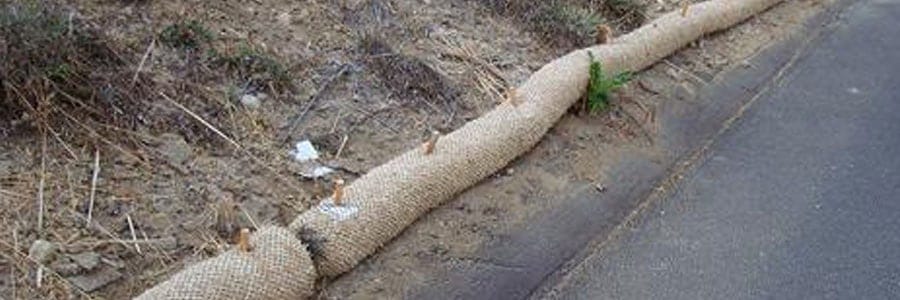
Also called rolls, straw/fibre wattles are made with bundled straw or other fibre of natural origin and wrapped in an open-weave plastic netting that is photo-degradable. Using wooden or live willow stakes, they are placed in the ground along slope contours. They are a grade break that naturally dissolves over time and does no harm to the environment.
In addition to a grade-break, wattles can retain moisture, sediment, and seeds that are otherwise washed downslope. The goal of placing straw/fibre wattles is to promote vegetation growth along the slope. The wattles themselves are usually 200mm in diameter and 8 to 9 m long. A recent development is the creation of mobile units that can produce continuous lengths of straw/fibre wattles.
Straw/fibre wattles can be a temporary or permanent erosion control measure depending on the material from which they are made. They can be used for stripping and grading and stabilization of the site itself. They are used for slopes, borrow areas, stockpiles, and landscaping purposes.
Implementation
– Remove large rocks and debris along the slope
– Repair rills and gullies along the slope
– Ensure upstream run-off is diverted from exposed slope
– Excavate small trenches across the slope starting at the toe
– Trenches must be deep and wide enough to hold straw/fibre wattles
– Wattles must be placed perpendicular to water movement and parallel to contour of slope
– Depending on steepness of slope, space trenches 1 to 8 m apart
– The steeper the slope, the closer the trenches should be
– Place straw/fibre wattles in trench. Make sure wattles are in contact with the soil
– Overlap wattle ends by at least 0.15 m by excavating additional trenches at overlaps
– Use metal bar to drive pilot holes for stakes through wattles and into soil.
– Keep stake spacing at less than 1.2 m. Leave 25 to 50 mm of stake exposed
– Excavated soil is placed and compacted on upside of wattle placement
– Place seeds on soil
Inspection & Maintenance
– Inspect wattles and sleep once per week. And after significant precipitation falls in the area
– Ensure strong contact of wattles to soil
– Repair undermining and rills quickly. Areas subject to rilling will need additional erosion controls
Over time, the organic fibres that make up the straw/fibre wattles along with the netting will decay. This is due to exposure to the sun. By the time the wattles decay, the grass and vegetation should be in place to hold the soil together at the base of the slope.
Tag: Sediment, erosion control, repair, slope, straw, bundled, debris, fibre, impementation, remove, rocks, rolls, trenches, wattles